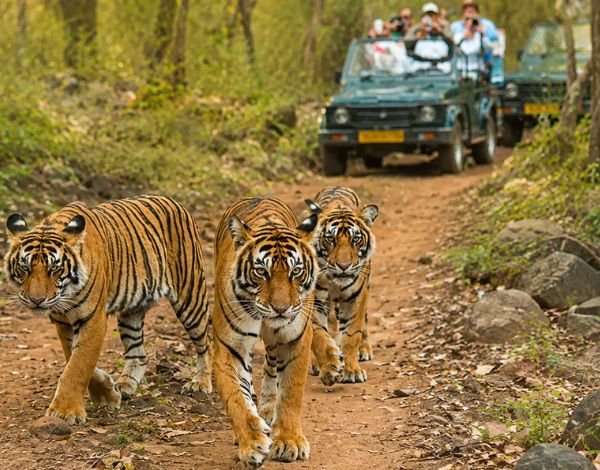
Rajaji National Park is best known for its Asian elephant population, one of the largest in India, along with a growing number of Bengal tigers, over 315 recorded bird species and its unusual setting where the Shivalik hills meet the Ganga floodplain.


About Rajaji National Park
Explore Safari Zones
About the Park
What Is Rajaji National Park?
Rajaji National Park is a protected forest and tiger reserve spread across the Shivalik foothills of Uttarakhand, where the outer Himalayan range gives way to the Indo-Gangetic plain. It takes its name from Chakravarti Rajagopalachari — "Rajaji" — a respected freedom fighter and India's first Indian-born Governor-General.
Unlike reserves built around a single sanctuary, Rajaji was stitched together from three older protected forests, giving it an unusually varied mix of terrain: dense sal woodland, riverine grassland, wetland fringes along the Ganga, and pine-covered upper ridges. That variety is exactly why the park supports both browsing elephants and ambush-hunting tigers within the same reserve.
- Spans Haridwar, Dehradun and Pauri Garhwal districts
- India's 48th Tiger Reserve, declared in April 2015
- One of the largest Asian elephant populations in India
Conservation History
How Three Sanctuaries Became One Tiger Reserve
1936
Motichur Protected as a Sanctuary
The Motichur forest, now one of the park's key elephant corridors, was first set aside for wildlife protection — decades before the modern park took shape.
1948
Rajaji Sanctuary Notified
The forest block that would eventually lend the reserve its name was formally notified as a wildlife sanctuary, the first of three pieces that later merged.
1977
Chilla Sanctuary Established
The Ganga-side Chilla forest, today the park's most-visited safari zone, was brought under formal protection, completing the trio of sanctuaries.
1983
Rajaji National Park Is Born
The Government of India merged the Rajaji, Motichur and Chilla sanctuaries into a single 820 sq. km protected area, officially notified as Rajaji National Park.
2002
Shivalik Elephant Reserve Notified
Rajaji became the core of the newly designated Shivalik Elephant Reserve under Project Elephant, recognising its importance to Asian elephant survival.
2015
Declared a Tiger Reserve
On 20 April 2015, Rajaji was upgraded to Tiger Reserve status — India's 48th, and only the second in Uttarakhand after Corbett — adding buffer forest to bring the reserve to just over 1,075 sq. km.
Geography & Location
Where Rajaji National Park Sits on the Map
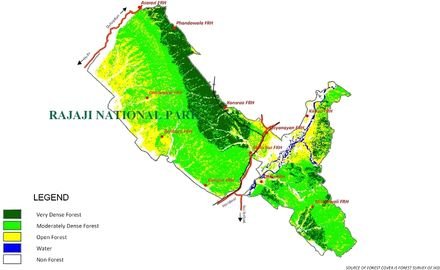
Rajaji National Park lies in the lower Shivalik hills of Uttarakhand, the youngest and southernmost range of the Himalayas, exactly where these low ridges flatten into the Gangetic plain. The reserve is spread across three forest divisions in Haridwar, Dehradun and Pauri Garhwal districts.
Rishikesh and Haridwar sit right on its eastern edge, which is what makes the park so accessible compared with reserves tucked deep in the Himalayan interior — most visitors reach a safari gate within an hour of arriving in either town.
- Districts: Haridwar, Dehradun and Pauri Garhwal
- Bordered by the Ganga river along its eastern flank
- Nearest towns: Rishikesh, Haridwar and Kotdwar
Flora
Sal Forest, Grassland and Pine on the Higher Ridges
Sal (Shorea robusta) dominates the lower and middle elevations, forming tall, closed-canopy stands that keep the forest floor open and give safari vehicles good sightlines. Mixed deciduous species such as khair, sissoo and rohini line the watercourses.
Where the forest breaks into riverside chaur grassland, tall elephant grass and seasonal wildflowers take over — prime grazing ground for herbivores. On the highest ridges above roughly 900 metres, chir pine forest appears, adding a third distinct habitat band within the same reserve.
Fauna
The Wildlife That Calls Rajaji Home
Rajaji sits at the north-western edge of both the tiger's and the Asian elephant's range in India, which shapes exactly which species you're likely to see here.

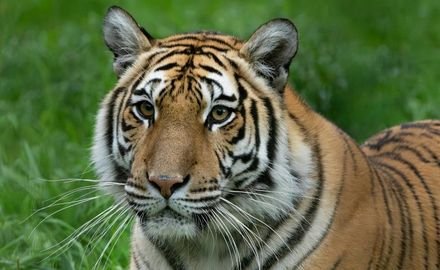
Bengal Tiger
Growing population, best odds at dawn.

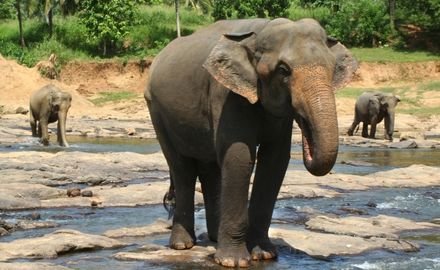
Asian Elephant
One of India's largest wild populations.

Leopard
Elusive, more active after dusk.

Sloth Bear
Frequent along forest-road edges or around the natural water holes.

Sambar & Spotted Deer
Common across grassland edges.

Great Hornbill
Canopy sightings, distinctive dawn calls.

315+ Bird Species
Resident and migratory, year-round.

Gharial & Mugger
Basking along the Ganga's edge.
Tiger Reserve Status
India's 48th Tiger Reserve
Rajaji Tiger Reserve was formally declared on 20 April 2015, making it only the second tiger reserve in Uttarakhand after Jim Corbett. The upgrade added roughly 255 sq. km of buffer forest from the Lansdowne and Haridwar forest divisions around the original 820 sq. km core, bringing the full reserve to just over 1,075 sq. km.
That buffer isn't a formality — it exists to give tigers room to disperse and breed beyond the strictly protected core, which is exactly what a growing, self-sustaining population needs over time.
Rajaji and Corbett together form the Rajaji-Corbett Tiger Conservation Unit — one of the reasons the corridor forest between the two reserves is treated as a conservation priority.
Safari Zones Overview
Five Safari Zones, Five Different Experiences
| Zone | Known For | Distance from Rishikesh/Haridwar | Best Suited For |
|---|---|---|---|
| Chilla | Elephants, tigers, river-edge grassland | ~8 km from Rishikesh | First-time visitors, families |
| Motichur | Elephant corridor, quieter trails | ~12 km from Rishikesh | Repeat visitors, photographers |
| Ranipur | Wetland birding, river-fed forest | ~6 km from Haridwar | Birdwatchers |
| Mohand | Deep sal forest, fewer vehicles | ~25 km from Rishikesh | Wildlife enthusiasts seeking solitude |
| Jhilmil | Hill terrain, mixed vegetation | ~30 km from Rishikesh | Landscape and terrain variety |
Zone timings, entry permits and gypsy availability change with the season — confirm current details on WhatsApp before you travel.
Why Rajaji Is Special
What Sets Rajaji Apart From Other Tiger Reserves
Rajaji doesn't try to be Corbett. Its value is in a different combination of things — proximity, elephant density and habitat variety in one compact reserve.
Closest Tiger Reserve to Delhi-NCR
Reachable in under six hours by road, making a genuine tiger-reserve safari possible on a short weekend trip.
Exceptional Elephant Density
Few reserves in India offer such consistent elephant sightings across almost every safari zone.
Three Habitats in One Reserve
Sal forest, river grassland and pine ridge sit within the same park — a habitat range most reserves don't offer.
Best Time to Visit
Matching Your Travel Dates to the Right Season
Nov – Feb
Cool, clear, comfortable safaris with strong elephant activity. Ideal for families and first-time visitors.
Mar – Apr
Generally the strongest sighting window of the season, as warming weather pushes wildlife toward waterholes.
May – Mid-Jun
Peak heat, but the driest stretch of the year often brings animals right up to the remaining water sources.
The park closes for the monsoon and breeding season from roughly mid-June to mid-November each year, in line with Forest Department rules.
Interesting Facts
Six Things Most Visitors Don't Know
Named After a Statesman
The park honours C. Rajagopalachari, a freedom fighter and India's first Indian-born Governor-General — not a place name.
Built From Three Sanctuaries
Rajaji, Motichur and Chilla sanctuaries were merged into one park in 1983 rather than being created from scratch.
Linked to Corbett
Forest corridors connect Rajaji to Jim Corbett National Park, allowing tigers and elephants to move between the two reserves.
A River Runs Through It
Rajaji is one of the few Indian tiger reserves with a major river, the Ganga, forming part of its natural boundary.
A Birder's Reserve Too
With 315+ recorded species, Rajaji is as rewarding for birdwatchers as it is for tiger and elephant spotters.
North-Western Frontier
Rajaji marks the north-western limit of the tiger's and Asian elephant's natural range in India.
Faq's
About Rajaji National Park — Frequently Asked Questions
-
What is Rajaji National Park famous for?
-
When was Rajaji National Park established?
Rajaji National Park was formed in 1983 when three older wildlife sanctuaries — Rajaji, Motichur and Chilla — were merged into a single protected area. It was later declared a Tiger Reserve in 2015.
-
How large is Rajaji National Park?
The core area of Rajaji National Park covers roughly 820 square kilometres. Including the buffer forest added when it became a Tiger Reserve, the full reserve spans just over 1,075 square kilometres.
-
Where is Rajaji National Park located?
Rajaji National Park lies in the Shivalik foothills of Uttarakhand, spread across Haridwar, Dehradun and Pauri Garhwal districts, close to Rishikesh and Haridwar city.
-
Why was Rajaji National Park declared a Tiger Reserve?
In April 2015, the park was declared India's 48th Tiger Reserve — and only the second in Uttarakhand after Corbett — because its Sal forests and grasslands support a viable, growing tiger population alongside a critical elephant corridor.
-
Who was Rajaji National Park named after?
The park is named after Chakravarti Rajagopalachari, popularly known as Rajaji, a respected freedom fighter, statesman and the first Indian-born Governor-General of independent India.
-
Which are the safari zones inside Rajaji National Park?
The main safari zones open to visitors are Chilla, Motichur, Ranipur, Kansro and Dholkhand. Each zone has its own gate, terrain and typical wildlife sightings, with Chilla and Motichur the most popular for first-time visitors.
-
What animals can be seen in Rajaji National Park?
Visitors can spot Asian elephants, Bengal tigers, leopards, sloth bears, sambar and spotted deer, and over 315 bird species including the great hornbill, alongside gharials and mugger crocodiles along the Ganga.
-
What is the best time to visit Rajaji National Park?
The safari season runs from mid-November to mid-June. November to February is cool and comfortable, March to April generally offers the strongest wildlife sightings, and May to mid-June brings the driest conditions and waterhole activity.
-
Is Rajaji National Park connected to Jim Corbett National Park?
Yes. Rajaji and Corbett form part of the same Terai-Arc wildlife landscape, and forest corridors between the two reserves are actively protected to allow tigers and elephants to move between them.